How to Stay Consistent With Workouts: 10 Strategies for Lasting Results
Staying consistent with workouts is one of the biggest challenges for many people, especially with busy schedules. At GlowFit, we believe that consistency matters more than intensity. In this article, you’ll learn how to stay consistent with workouts using simple, realistic strategies that fit into everyday life and support a healthy lifestyle.
How to Stay Consistent With Workouts When Motivation Is Low
Why motivation fades over time
Motivation is emotional. It spikes when you’re inspired and crashes when life gets busy. Research shows motivation naturally fluctuates, which is why relying on it alone leads to inconsistency (American Psychological Association).
Discipline vs motivation
Discipline is doing the workout even when you don’t feel like it. Think of it like brushing your teeth—you don’t debate it; you just do it. The goal is to make workouts automatic, not emotional.
How to Stay Consistent With Workouts as a Busy Woman
Time scarcity explained
Busy women often believe workouts must be long to be effective. That belief alone kills consistency.
The myth of “perfect workout time”
There is no perfect time—only available time. A 15-minute workout done consistently beats a 60-minute workout done once a month.
The Psychology Behind Workout Consistency
Habit formation basics
According to research published in the European Journal of Social Psychology, habits form through repetition—not intensity. Consistency creates automatic behavior.
Identity-based habits
Instead of saying “I’m trying to work out,” say “I’m someone who moves daily.” Identity-driven habits last longer (James Clear, Atomic Habits).
How to Stay Consistent With Workouts Using Small Wins
Micro-workouts
Short workouts remove resistance. Ten squats, five push-ups, a quick walk—it all counts.
The 5-minute rule
Promise yourself five minutes. Once you start, momentum usually follows. If not, stopping is allowed—no guilt.
Setting Realistic Fitness Goals That Stick
Outcome vs process goals
- Outcome goal: Lose 10 pounds
- Process goal: Work out 3x per week
Process goals are within your control—and they drive results.
SMART goal framework
Specific, Measurable, Achievable, Relevant, Time-bound. This framework is widely supported in behavioral science (CDC).
Creating a Simple Workout Routine You’ll Actually Follow
Frequency over intensity
Three moderate workouts weekly are more sustainable than extreme daily sessions.
Weekly structure example
| Day | Workout |
|---|---|
| Monday | Full body |
| Wednesday | Lower body |
| Friday | Upper body + core |
Simple. Repeatable. Effective.
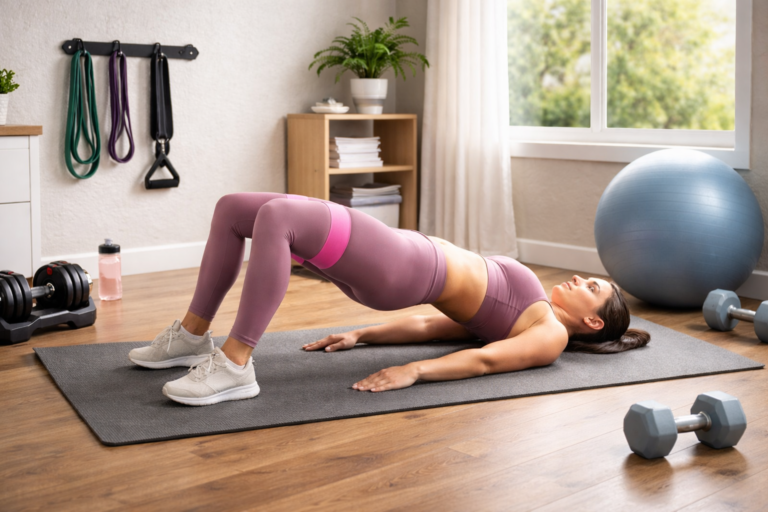
How to Stay Consistent With Workouts at Home
Home workout advantages
- No commute
- Flexible timing
- Lower mental resistance
Studies show home workouts improve adherence for beginners (Harvard Health Publishing).
Minimal equipment setup
You only need:
- Resistance bands
- Dumbbells
- A mat
That’s it.
The Role of Accountability in Fitness Consistency
Social accountability
Tell a friend. Join a group. Share progress. Accountability increases follow-through by up to 65% (American Society of Training and Development).
Tracking progress
Tracking workouts—even with simple checkmarks—boosts consistency by reinforcing success.
Product Recommendations to Support Workout Consistency
Adjustable Dumbbells
Best for: Strength training at home
Benefits: Space-saving, progressive overload
Who it’s for: Beginners to intermediate users
Resistance Bands Set
Best for: Low-impact workouts
Benefits: Joint-friendly, portable
Who it’s for: Busy women and beginners
Fitness Tracker
Best for: Habit tracking
Benefits: Motivation, data feedback
Who it’s for: Anyone who likes visual progress
Non-Slip Yoga Mat
Best for: Home workouts
Benefits: Safety, comfort
Who it’s for: All fitness levels
How to Stay Consistent With Workouts Through Plateaus
Mental plateaus
Plateaus are normal. They don’t mean failure—they mean adaptation.
Program variation
Change reps, exercises, or format every 4–6 weeks to maintain engagement.
Common Mistakes That Kill Workout Consistency
All-or-nothing thinking
Missing one workout doesn’t mean quitting. Consistency is built over months, not days.
Overtraining
Too much intensity leads to burnout. Recovery is part of progress.
Nutrition, Recovery, and Consistency
Fueling workouts
Eating enough protein and calories supports energy and recovery (Mayo Clinic).
Sleep and stress
Poor sleep reduces motivation and physical performance. Prioritize rest.
How to Stay Consistent With Workouts Long Term
Lifestyle integration
Fitness should fit into your life, not disrupt it.
Seasonal flexibility
Some weeks are lighter—and that’s okay. Long-term consistency beats short-term perfection.
Conclusion
Learning how to stay consistent with workouts isn’t about willpower. It’s about smart systems, realistic expectations, and treating fitness like a lifelong habit—not a temporary challenge. Start small. Stay flexible. And remember: consistency always wins.
FAQs
1. How many workouts per week are enough to stay consistent?
Two to three workouts per week are enough for beginners.
2. Is it okay to miss workouts sometimes?
Yes. Progress is about patterns, not perfection.
3. Are home workouts effective long term?
Yes. Research confirms home workouts improve adherence and results.
4. How long does it take to build workout consistency?
Most habits form within 8–12 weeks with repetition.
5. What’s the best workout for busy women?
Short, full-body workouts using resistance training.

6 Comments